

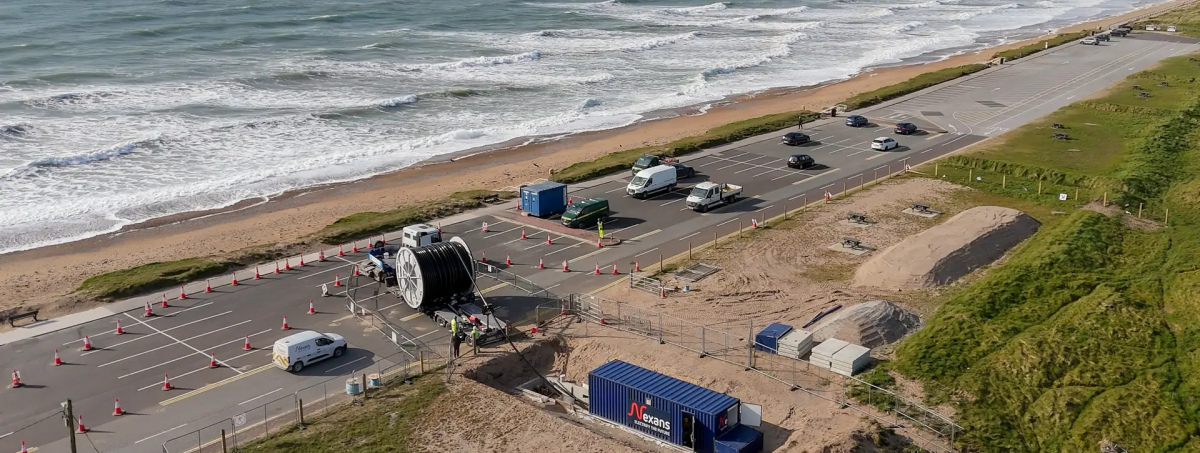
EirGrid announced on 28 May 2026 that onshore cable installation for the Celtic Interconnector in Ireland is complete and that the onshore cable connections have been successfully tested. When delivered, the link will exchange 700 megawatts of electricity, equal to powering 450,000 homes, through a 500 kilometre subsea cable to France. The project is delivered in partnership with RTE, France’s transmission operator, with funding from the European Commission’s Connecting Europe Facility. The link will strengthen Ireland’s grid, connect it directly to Europe and support the energy transition. For engineering companies and the engineering industry across electrical engineering, civil engineering ireland and infrastructure engineering disciplines, it is a national reference project for transmission-scale project delivery.
The onshore achievement is considerable. Some 44 kilometres of high voltage alternating and direct current cable have been installed, jointed and tested, and are operationally ready. Works at Claycastle Beach in east Cork are complete, ready for the subsea cable from France to come ashore. Specialist construction methods installed the cable beneath Ballyvergan Marsh while protecting its sensitive environment. EirGrid’s chief financial officer noted that the programme included horizontal directional drilling, live rail crossings and a number of river crossings, each requiring careful engineering design and planning. Construction broke ground just over two and a half years ago, and the delivery reflects strong collaboration between project teams and contract partners.
Offshore works are progressing steadily. Cable protection and burial are under way in Irish waters following the installation of 84 kilometres of cable last year, and 97 kilometres have been laid in French waters this year. EirGrid’s June 2026 newsletter reports that converter station compound construction is complete, that final permanent road reinstatement has been completed along the cable routes and that the commissioning and testing phase is beginning. The converter station at Ballyadam converts alternating current to direct current for transfer to France, where a converter station in Brittany converts it back.
The engineering disciplines involved are wide. Structural engineering and civil works underpin the converter station, trenching, ducting and landfall. Mechanical engineering ireland capability supports plant and cooling systems, while manufacturing of high-voltage cable, joints and converter equipment forms the supply chain. Electrical engineering covers high-voltage design, protection and system testing. Engineering technology, including monitoring and survey, supports cable burial and protection. Sustainable engineering and sustainability in engineering are visible in the careful construction at Ballyvergan Marsh and in the project’s purpose, which strengthens the grid and supports renewable energy integration.
Three priorities follow for the sector. Engineering companies should capture lessons from the programme, including crossing methods, environmental controls and testing regimes, and apply them to future engineering projects in transmission and offshore connection. Firms with high-voltage, civil and marine capability should prepare for the pipeline of grid work ahead. Teams should invest in commissioning and testing skills, since engineering excellence in this phase protects long-term performance. Engineering innovation in cable protection and burial will keep Irish firms competitive, and engineering leadership shown on this project will inform the next generation of interconnection.







.png)